
The Art of Not Knowing
On learning to make peace with uncertainty, even when your brain is screaming for control.

I have recently been caught up in the dilemma of trying to differentiate between what we can and can’t control.
Someone asked me recently about my longer term plans for staying in Europe as opposed to ending up back home in Cape Town, and I kind of froze in the uncertainty, because the reality is… I have no idea what I’ll do or where I’ll end up, I’m just taking things day by day.
My brain is a cruel mistress
Isn’t it ironic that the universal truth across every religious text, every spiritual mantra, is that we ultimately have no real control of what happens to us, yet the one thing our brains so desperately cling to is control?
I wonder about all of the different ways that evolution could have developed our brains, where maybe the ability to survive somehow wouldn’t depend on our minds being constantly gas-lit by our paleolithic instincts that crave as much certainty as possible to ensure basic survival.
(Dear caveman ancestor who was just trying his best to not get eaten by a wolf or choke on a poisonous berry, I forgive you.)
The daily struggle
At the end of the day, it’s all a myth right? The idea that we have some kind of real control over things: over time and nature, over traffic or the weather, over how other people perceive us, or best of all, how other people will behave.
And yet, despite the fact that we all intellectually know and understand this basic principle, I don’t think we really internalize it well, and in my case I don’t think I intuitively live by this principle. I think that, unfortunately, I still react to things more often than I’d like to, expecting them to be a certain way or trying to control them as much as possible, only to suffocate them.
I know, I know, we’re only human, but sometimes it feels like we’re swimming upstream in a river of heavy quicksilver, trying to fight ‘nature’ by imposing a measure of control over the world around us. I remember when I lived in Amsterdam four or five years ago, and whether I was cycling to or from somewhere, it somehow always felt like the wind was working against me, blowing into my face and tiring me out.
That’s life, sometimes: a perpetual headwind.
The paradox of surrender
The irony is not lost on me that a profound parody exists in the world: the more we try to control things, the more we suffer because the universe inevitably does its thing and disrupts our expectation of what we think will happen with its own version of events (almost every time…).
And on the flipside, the less we resist the uncertainty of the universe: the rhythm of chaos, the last minute changes, the unexpected curveballs, the more we are able to flow with the universe and at least not feel like we’re struggling against it.
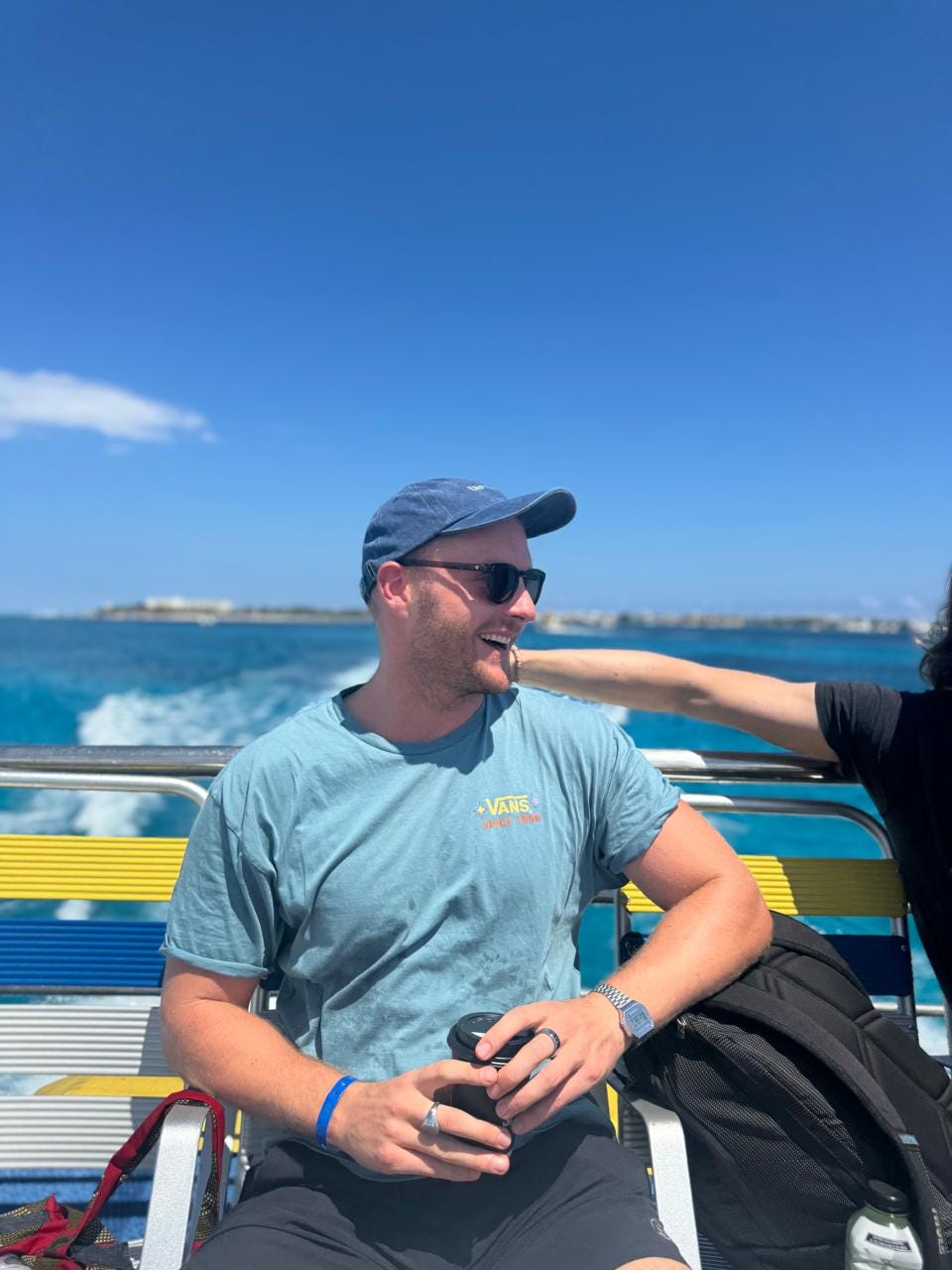
To not know is a skill
And so, I go back to this idea of saying ‘I don’t know’ when somebody asks me a big life question (or even when they ask me what I’m up to this weekend…).
There is this knee-jerk reaction to feel guilty or weird about not having an answer to these questions or not having a plan, because having answers and plans is in some ways synonymous with having control, I suppose.
But if you go back to core life underlying lesson numero uno (see above), we remember that, oh right, control is a myth.
So based on this mathematical equation (life + control = false), there is I guess nothing to feel bad about when our answer to a question is “I don’t know”. Because anyone that does have a precise answer or a specific plan to any big question in life, is ultimately clinging to an idea or a hope, essentially, that the future will play out in a way that aligns with what their brain is telling them in the here and now.
Float like a jellyfish
I guess the answer to the above dilemma is to live in some kind of fluid state of perpetual motion and adaptation, like a graceful jellyfish that springloads its stringy tentacles before propelling itself forward in whatever direction the current may or may not be flowing.
That’s probably an unrealistic overshot reserved only for the highest of monks; the ones who have trained themselves over the course of a lifetime in the art of non-attachment.
So maybe there’s a middle ground for the rest of us, where we live in some kind of in-between state? Where we adapt to the current and the way the water flows, but keep some kind of general sense of direction, gently clasping onto a rusty compass with one of our many tentacles to at least maintain a sense of whether we’re floating east, north, south, or west.
But what do I know?